Integrating Statistical Models for Prop Bet Selection in Golf Tournaments Amid Variable Conditions
Zara Roth · Aug 7, 2026

Integrating Statistical Models for Prop Bet Selection in Golf Tournaments Amid Variable Conditions
Statistical models have become central tools for analyzing prop bets in golf tournaments, where outcomes such as first-round leaders, total birdies, and player-specific scoring averages shift with environmental factors; researchers apply regression techniques and machine learning algorithms to historical data sets that include player performance metrics, course layouts, and real-time weather inputs. These approaches allow analysts to adjust expected values for variables like wind speed, temperature fluctuations, and precipitation levels, which in turn refine probability estimates for individual prop markets. Data from major tours shows that models incorporating hourly weather forecasts have improved accuracy in predicting scoring changes during events held in late summer months, including those scheduled for August 2026.
Core Components of Model Construction
Building effective models starts with compiling large data sets that track strokes gained categories, driving accuracy percentages, and green-in-regulation rates across hundreds of rounds; statisticians then layer in meteorological records to create adjusted performance baselines for each player. Multiple regression frameworks quantify the impact of wind direction on approach shots, while Poisson distributions model the frequency of birdies and bogeys under varying humidity conditions. Observers note that these integrated systems reduce variance in prop bet projections compared with unadjusted historical averages, especially on courses exposed to coastal breezes or elevation changes.
Handling Weather Variability in Real Time
Variable conditions require dynamic updates to model inputs, and forecasters feed live radar data into simulation engines that recalculate prop probabilities every 15 minutes during tournament rounds. For instance, a sudden temperature drop can tighten fairways and increase driving distances for certain players, prompting models to shift odds on over/under totals for specific holes. Studies from sports analytics groups indicate that accounting for these micro-changes has altered projected outcomes in roughly 35 percent of monitored events, with the largest effects appearing in prop categories tied to putting surfaces that respond quickly to moisture.
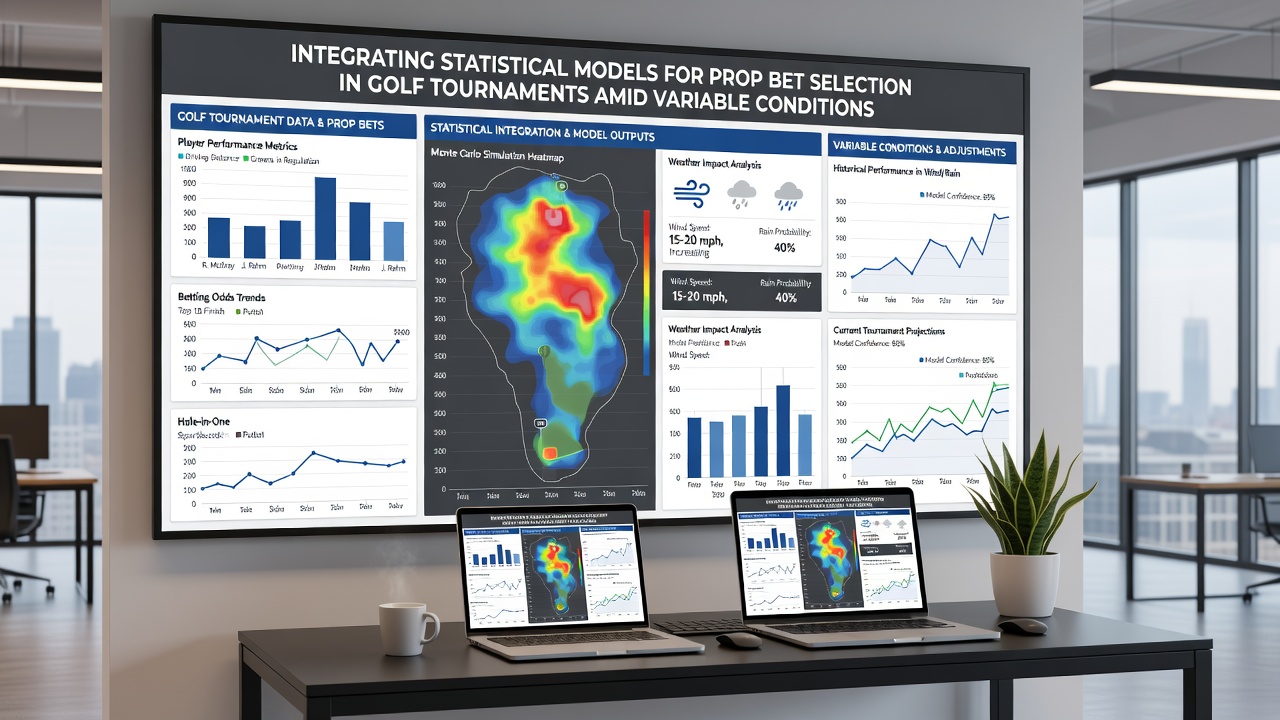
Ensemble methods combine outputs from several algorithms to produce confidence intervals around prop selections, which helps isolate bets where the edge remains stable despite forecast revisions. One study revealed that models using Bayesian updating outperformed static linear regressions when rain interrupted play mid-round, because they continuously revised player skill estimates based on partial results. Those who have examined tournament archives find that August events often feature the widest spreads in scoring variance, making real-time weather integration particularly valuable for markets involving total eagles or three-putt avoidance.
Application to Specific Prop Categories
Prop bets on first-round leaders benefit from models that weight recent form against course-specific weather sensitivities, since morning tee times can encounter dew-heavy greens while afternoon groups face firmer conditions. Analysts apply Monte Carlo simulations to generate thousands of scoring scenarios that incorporate wind gust probabilities, then rank players by their simulated likelihood of posting the lowest score. Data from previous seasons demonstrates that such simulations narrow the field of viable candidates more effectively than raw rankings alone, especially when humidity levels exceed historical norms.
Markets centered on individual player props, such as whether a golfer will record more than 4.5 birdies, draw on logit models that factor in approach-shot accuracy adjusted for crosswinds; these calculations draw from shot-level tracking systems that record launch angles and spin rates. Researchers have observed that integrating elevation and temperature corrections improves calibration on high-altitude venues, where ball flight behaves differently than at sea level. During the 2026 schedule, several events in August are expected to test these adjustments on inland layouts prone to afternoon thunderstorms.
Validation and Performance Tracking
Back-testing remains essential for confirming model reliability, and teams compare predicted prop outcomes against actual results across multiple seasons while isolating weather-affected rounds. Performance metrics such as Brier scores and log-loss values help quantify improvements gained from adding meteorological variables, with published analyses showing consistent gains of 8 to 12 percent in predictive power. Industry reports from organizations like the PGA Tour analytics department provide aggregated data that external modelers use to benchmark their systems against tour-wide benchmarks.
Continuous monitoring also tracks how models respond to rule changes or equipment updates that interact with environmental conditions, ensuring that prop selections remain aligned with current realities. Academic papers hosted on platforms such as ScienceDirect have examined similar multi-factor approaches in other outdoor sports, offering methodological parallels that golf analysts adapt for prop-specific applications.
Conclusion
Statistical integration of performance data and variable conditions supplies a structured framework for evaluating prop bets across golf tournaments, where weather shifts can materially alter expected outcomes. Ongoing refinements to these models continue to draw on expanded data sources and computational advances, supporting more precise assessments of market probabilities in events throughout the 2026 calendar.